
"Grade II"
600 article(s) found

Is Brazil's Minas Coffee famous? the coffee history of Brazil, the world's largest coffee producer.
Professional coffee knowledge exchange more coffee bean information Please follow the coffee workshop (Wechat official account cafe_style) the global trend of modern coffee has gone through three popular stages, the first stage is the popularity of cheap coffee represented by instant coffee from the post-World War II to the 1960s, and the second stage is the commercial coffee popularity represented by Starbucks from the 1960s to the beginning of this century.

Introduction of taste grinding scale of varieties produced by Lim Manor in African coffee producing area
Introduction to the Grinding scale of the varieties treated in Lim Manor in African Coffee producing area Water washing: Grade-1;Grade-2 Solar: Grade-3;Grade-4;Grade-5 and Grade-1 several points to note: a) both washing and solarization, there is Gr-1, the condition is zero defect and Premium Cup. Whether it's washing or tanning, Gr-1 is the best of the boutiques or Cup of Exce.

Introduction to the story characteristics of Ethiopian boutique coffee beans
The highest grades of Ethiopian coffee are grade 2 and 3 (Yirgacheffe, Sidamo), while sun-processed coffee in eastern Ethiopia is mostly grade 4 or grade 5 (G4, G5). In many cases, the coffee label of level 4

Introduction to Ethiopian Coffee Grade
Grade of Ethiopian coffee: Ethiopian washed coffee Yega Chuefei G1 G2 Sidamo (Yirgacheffe, Sidamo) has the highest grades 2 and 3 (G2, G3), while sun-processed coffee in eastern Ethiopia is mostly grade 4 or 5 (G4, G5). In many cases, level 4 coffee is marked as level 5 in order to reduce taxes. At present, the classification is not uniform and there are

Introduction to the difference between Sidamo Coffee Flavor description and Yega Xuefei
Introduction to the difference between Cedamo Coffee Flavor description and Yega Chuefei Coffee the highest grades of Yirgacheffe and Sidamo are Grade 2 and Grade 3 (G2, G3), while most of the sun-processed coffee in eastern Ethiopia are Grade 4 or Grade 5 (G4, G5). In many cases, level 4 coffee is marked as level 5 in order to reduce taxes

Indonesia Sumatra Lindong Mantenin imported G1 boutique coffee beans grind degree roasting degree treatment
During the Japanese occupation of Indonesia during World War II, a Japanese soldier drank mellow coffee in a cafe, so he asked the shopkeeper the name of the coffee, and the boss mistook him for asking where you were from, so he replied: Mandaining. After the war, the Japanese soldiers recalled the manning they had drunk in Indonesia. As a result, 15 tons of Indonesian coffee was transported to Japan, which was very popular. That's the name of Manning.

Introduction to the flavor and taste of Ethiopian Arabica coffee
In the field of boutique coffee, there are also five other small places of coffee, namely Lim, Gemma, Le Campdi, Becca and Limmu, Djimmah, Lekempti, Bebeka and Wolega. The most common is Essesidamo or Harald coffee (Either Sidamo or Harrar coffee). Harald Coffee (HarrarCoffee) is made in Essex.

Ethel Biaxidamo G1 Solar Coffee Bean Flavor description Variety taste area introduction
In order to produce high-quality coffee beans, professional management team will make full use of shade trees and natural conditions. in the production of high-quality coffee while minimizing the impact on the natural environment. In this way, we can protect the ecological environment, social development and the well-being of community workers.

Flavor description of Ethiopian Honey Coffee beans introduction to Grinding scale Variety Manor
The Flavor description of Ethiopian Honey Kiss Coffee beans Grinding scale Variety Manor introduces that Ethiopia grows coffee in different climatic zones, so it has more than 140 farm varieties, and fresh coffee is produced all the year round. The quality of Ethiopian coffee varies according to different elevations and regional ecological environment. Harar coffee in the southeast highlands is a typical Muhaka.

Guji, Ethiopia G1 washed sun-cured coffee beans flavor description treatment of variety characteristics
Ethiopian coffee flavor description introduces Ethiopia's Yirgacheffe coffee, although petite, it is gentle and delicate, sweet and lovely. As the hometown of coffee, thousands of years of planting history and processing tradition in Ethiopia have created high-quality washed Arabica beans. Light baking has a unique sweet aroma of lemon, flower and honey, with soft acidity.

A brief introduction to the flavor and taste characteristics of Ethiopian coffee manor with rich alcohol thickness
In the West, Ethiopian coffee is generally sold on the market as Yega Feixidamo and Harald (Yirgacheffee, Sidamo and Harrar). The highest grades of Ethiopian washed coffee Yega Chuefei G1 G2 Sidamo (Yirgacheffe, Sidamo) are Grade 2 and Grade 3 (G2, G3), while most of the sun-processed coffee in eastern Ethiopia are Grade 4 or Grade 5 (G4, G5).

Introduction to the quality characteristics of the Lion King Flavor description method in Sidamo, Ethiopia
Ethiopian coffee beans introduce Ethiopia's Yirgacheffe coffee, although petite, it is gentle and delicate, sweet and lovely. As the hometown of coffee, thousands of years of planting history and processing tradition in Ethiopia have created high-quality washed Arabica beans. Light baking has unique sweet aromas of lemon, flower and honey, soft acidity and citrus.

What are the characteristics of Sumatran gold manning? you can't drink gold manning in one mouthful.
Professional coffee knowledge exchange more coffee bean information please follow the front street of the coffee workshop (Wechat official account cafe_style)-Golden GOLDEN MANDHLING Coffee in the 1950s a new merchant was opened in the city of Medan, Indonesia, named PAWANI, which is known to coffee fans as, the founder of Golden GOLDEN MANDHLING. According to many documents, it was recorded by World War II.

Stories and allusions of Indonesian Sumatra Mantenin boutique coffee beans in Qianjie
During the Japanese occupation of Indonesia in World War II, a Japanese soldier drank mellow coffee in a cafe, so he asked the shopkeeper the name of the coffee, and the owner mistook him for asking where you were from, so he replied: Mandaining. After the war, the Japanese soldiers recalled the manning they had drunk in Indonesia. So he entrusted Indonesia.
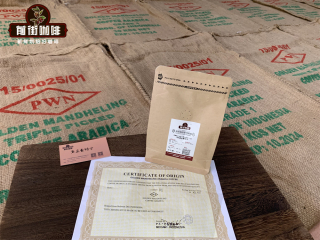
The story of the history of the name of Mantenin in Sumatra, Indonesia what is the price characteristics of golden manning coffee beans?
Mandenin's name is the transliteration of Indonesia's Mandaining mandheling clan. During the Japanese occupation of Indonesia during World War II, a Japanese soldier drank mellow coffee in a cafe, so he asked the shopkeeper the name of the coffee. The boss mistakenly thought he was asking where you are from.

Introduction to the flavor description and grinding characteristics of Ethiopian coffee varieties in producing areas
Grade of Ethiopian coffee: Ethiopian washed coffee Yega Chuefei G1 G2 Sidamo (Yirgacheffe, Sidamo) has the highest grades 2 and 3 (G2, G3), while sun-processed coffee in eastern Ethiopia is mostly grade 4 or 5 (G4, G5). In many cases, level 4 coffee is marked as level 5 in order to reduce taxes. At present, the classification is not uniform and there are

Description of beloya Flavor of Yega Xuefei in Solar Water; introduction to the characteristics of varieties in the region
Sun Yega Chuefei Coffee Flavor description Sun Yega Chuefei G3, bold, wild fruit syrup-like sweetness, very mellow thickness, in addition to its own citrus and lemon aromas, blueberry berries are amazing in the northern part of the Great Rift Valley, dotted with a series of lakes set like pearls in the Horn of Africa. Lake Turkana stretches from Kenya to Ethiopia

Classification standard of raw coffee beans
There are two ways to classify raw coffee beans, one is the filter number, and the other is the elevation.

Geographical characteristics of Sidamo producing area in Ethiopia; description of coffee flavor in manor; introduction to planting environment
Ethiopian coffee beans 1. When picking beans, only fully ripe crimson coffee cherries are picked. Before exposure, the beans will be screened for defects in the processing plant to make the beans look more average in size and maturity. two。 Next, use tall wooden frames or whole scaffolding for the sun to avoid the risk of beans smelling on the ground. In the process of exposure,